Does WordPress still run 43% of the web? Three datasets put it between 31% and 39% in late 2026
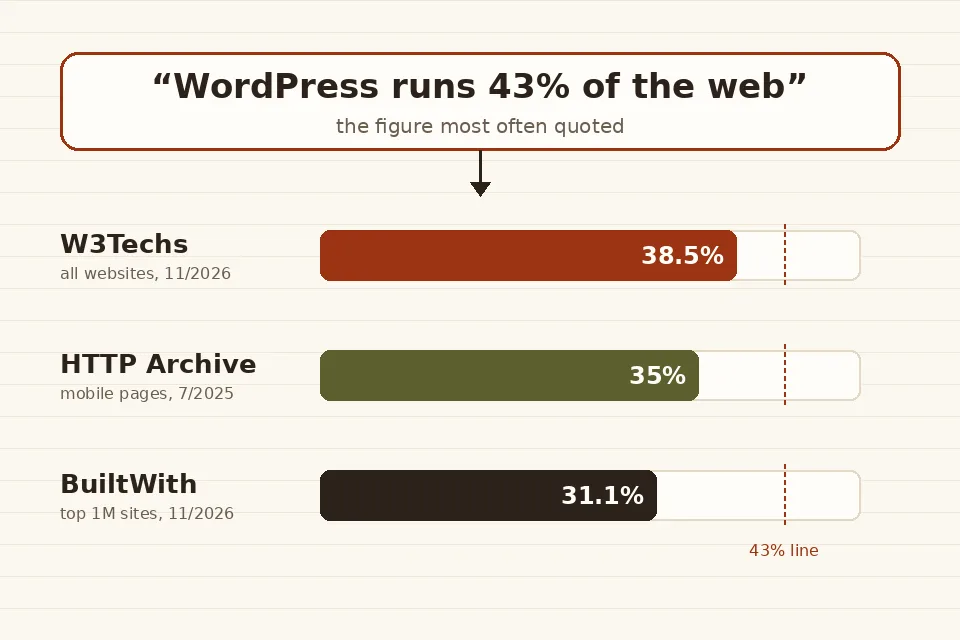
"WordPress powers 43% of the web" is one of the most repeated numbers in web publishing. It turns up in hosting adverts, agency pitches and conference slides. We checked it against the three public datasets that measure the web's software. In November 2026 none of them says 43%: they say 38.5%, about 35% and 31%, depending on what is counted.
W3Techs: 38.5% of all websites, down from 43.0% on 1 January 2026.
HTTP Archive: about 35% of mobile pages crawled in July 2025, flat since 2022.
BuiltWith: 310,672 of its top 1 million sites, or 31.1%.
Among sites whose CMS can be identified, WordPress still holds 57% to 64%.
Where the 43% comes from
The number belongs to W3Techs, whose yearly history report shows WordPress on 43.2% of all websites on 1 January 2022, 43.1% in 2023 and 2024, 43.6% in 2025 and 43.0% on 1 January 2026. For four years the figure barely moved, which is why it hardened into a fact that nobody felt the need to re-check. Before that it climbed steadily, from 23.3% in January 2015 to 35.4% in 2020 and 39.5% in 2021.
W3Techs measures what it calls the "relevant web". According to its methodology page, the sample "includes well over 20 million sites", excludes parked domains, default server pages and duplicates, and counts a site once, not each of its subdomains. Its crawler looks for signatures in the pages, such as the generator meta tag, file paths and HTTP headers.
What changed in 2026
The W3Techs monthly report shows a slow slide all year: 42.8% on 1 February, 42.2% on 1 May, 41.5% on 1 July, 40.2% on 1 October and 39.5% on 1 November. On 21 November 2026 the WordPress page reads 38.5% of all websites and 57.4% of the sites whose content management system is known.
The trade press noticed in the spring. Search Engine Journal reported on 28 May 2026 that WordPress had lost share "for six months in a row", with a drop that by then was already double the decline of the whole of 2025. The fall has steepened since: about 1.1 points between 1 January and 1 June, then 3.4 points between 1 June and 21 November.
The detail that matters is where the lost share went. Between 1 January and 21 November 2026, WordPress lost 4.5 points of all websites. Over the same period, the share of sites using no CMS that W3Techs detects rose from 28.6% to 33.0%, a gain of 4.4 points. Shopify gained 0.4 points; Wix and Squarespace did not move. So in this dataset WordPress is not mainly losing sites to a rival CMS. It is losing ground to sites that W3Techs classifies as having no CMS at all, which includes hand-coded sites and sites built on JavaScript frameworks. W3Techs itself noted in October that Next.js grew from 1.9% to 3.7% of all websites in a year. W3Techs does not publish an explanation for the shift, and we have not found one in its reports, so we do not claim a cause.
The second dataset: HTTP Archive
HTTP Archive crawls several million sites every month from the list of origins in Google's Chrome UX Report, then publishes an annual analysis, the Web Almanac. It counts pages rather than sites, and it reports desktop and mobile crawls separately.
In the 2024 CMS chapter, WordPress was found on 35.1% of mobile pages in 2022, 34.9% in 2023 and 35.6% in 2024. The 2025 chapter, based on the July 2025 crawl, gives 35.0% for all websites in its ranking chart and describes a year-on-year decline of "less than one percentage point" from the 2024 peak. Among pages with an identified CMS, WordPress accounts for 64.3%, ahead of Shopify (7.3%) and Wix (5.2%). The chapter sums up the year in one phrase: WordPress's "first sustained slowdown after decades of expansion".
HTTP Archive has never put WordPress at 43%. Its figure is lower because its sample is different: it is built from sites that Chrome users actually visit, including large platforms, web apps and online shops, rather than from a broad catalogue of content sites.
The third dataset: BuiltWith
BuiltWith is a commercial technology tracker. On 21 November 2026 its WordPress trends page listed 36,474,749 live websites using WordPress, plus 51 million that used it in the past. It does not publish a single "share of the web", but it does break its live sites down by its own traffic ranking:
| BuiltWith ranking tier | WordPress sites | Share of the tier |
|---|---|---|
| Top 1,000 | 209 | 20.9% |
| Top 10,000 | 1,812 | 18.1% |
| Top 100,000 | 18,280 | 18.3% |
| Top 1 million | 310,672 | 31.1% |
The shares are our calculation (sites divided by the size of the tier). They show something the headline figure hides: WordPress is far more common among ordinary sites than among the most visited ones, where custom stacks and enterprise platforms dominate. HTTP Archive sees a similar pattern by rank, although among the top 10,000 sites that use a CMS, WordPress still accounts for roughly 58%.
Side by side
| Dataset | What it counts | WordPress | Date |
|---|---|---|---|
| W3Techs | Share of over 20 million "relevant" websites | 38.5% | 21 Nov 2026 |
| W3Techs | Share of sites with a known CMS | 57.4% | 21 Nov 2026 |
| HTTP Archive | Share of mobile pages crawled | 35.0% | July 2025 |
| HTTP Archive | Share of mobile pages with a CMS | 64.3% | July 2025 |
| BuiltWith | Share of its top 1 million sites | 31.1% | 21 Nov 2026 |
So what can you honestly say?
"WordPress runs 43% of the web" was a fair summary of one dataset from 2022 to the start of 2026. It is out of date now. Statements that the data supports in November 2026:
- "WordPress runs about 38% of websites (W3Techs, November 2026)." Always give the source and the month; this figure is moving.
- "WordPress runs well over half of all sites that use a CMS." All three datasets agree on this, and it is the more stable claim.
- "WordPress is the most used CMS by a wide margin." In every dataset, the runner-up has a fraction of its share.
What the data does not support is a story of WordPress collapsing. HTTP Archive was flat for four years, and BuiltWith still counts more than 36 million live WordPress sites, about four times its count for Wix (8.8 million). Nor does it support a single cause. The fall in W3Techs began after a year of public conflict inside the WordPress community, including the lawsuit WP Engine filed against Automattic in October 2024, as TechCrunch reported. But the share lost in 2026 went mostly to "no detected CMS", not to the commercial builders, which points as much to how sites are being built as to who builds them.
For site owners, the practical lesson is unchanged. A platform's market share says little about whether it suits your site. What matters day to day is whether it is kept current: see our guide to automatic updates and rollbacks, and the Site Health checks that show when a site is falling behind. For how the plugin ecosystem that drove WordPress's growth came about, read how WordPress plugins began.
Download the data
The W3Techs and HTTP Archive figures used in this article are in a small CSV file, one row per figure, with the source page for each: wordpress-share-datasets-2026-11.csv. Reuse is free with a link to this page; the underlying figures belong to their publishers, and W3Techs asks that any quotation link to its original page. BuiltWith figures are not included in the file, because BuiltWith does not publish a reuse licence; they are quoted above with a link.
Methodology
All three sources were read on 21 November 2026. W3Techs figures come from its WordPress page, its yearly history (values on 1 January of each year, plus the current value) and its monthly history. HTTP Archive figures come from the CMS chapters of the 2024 and 2025 Web Almanac (mobile crawl; the 2025 edition uses the July 2025 crawl). The 2025 chapter gives 35.0% in its ranking chart while one figure caption states 35.6%; we use 35.0%, which matches the chapter's description of a small decline from 2024. BuiltWith figures come from its public WordPress trends page; the tier shares are our own division of its site counts by the tier size. Percentages are rounded to one decimal. Each source detects WordPress differently, and a site can hide its software, so all three figures are estimates; we compare their trends rather than treating any one as exact.
Free to reuse with a link to this page. Plain Hooks is independent and has no commercial relationship with W3Techs, HTTP Archive, BuiltWith or any CMS vendor.
 History
How WordPress plugins began
From hooks in WordPress 1.2 to one-click installs, background updates and plugin dependencies: twenty years in a few steps.
 Logins & site admin
Updates and auto-updates
What updates itself, what waits for you, what the rollbacks really do, and a monthly routine that keeps a small site current without surprises.
 Logins & site admin
Site Health explained
What the Site Health screen checks, which critical issues to fix first, the warnings a small site can leave alone, and how to share the Info tab without oversharing.