xmlrpc.php: a short history of the WordPress API that is still switched on
Open the server logs of almost any WordPress site and you will find requests to a file most site owners never asked for: xmlrpc.php. It sits in the root of every install, it answers to the whole internet, and it predates the block editor, the REST API and most of the plugins on the site. Its story is a good summary of how WordPress grew up: an open publishing protocol, then a convenience switched on for everyone, then an attack surface, and finally a legacy API that core still keeps alive.
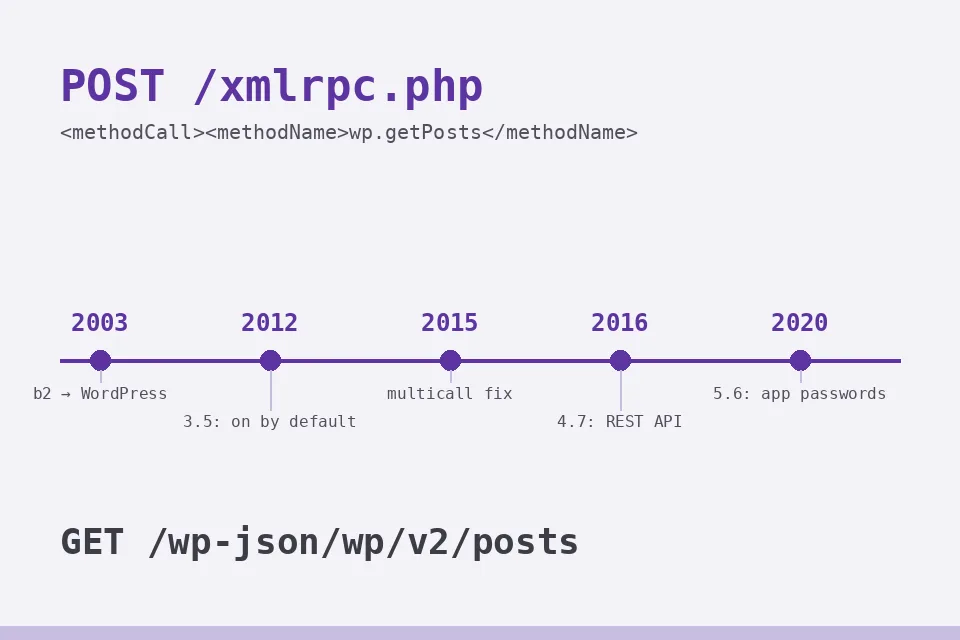
In short: XML-RPC let desktop and mobile editors publish to WordPress long before the REST API existed. It has been on by default since WordPress 3.5 (2012), was abused for DDoS and password guessing in 2014 and 2015, and was superseded by the REST API in 4.7 (2016). If nothing on your site uses it, blocking it is reasonable; if Jetpack or an old publishing app does, harden it instead.
A protocol from 1998
XML-RPC is older than WordPress. Designed in 1998 at Dave Winer's UserLand Software, with Microsoft, it is a simple way for one program to call a function on another over HTTP: the request is an XML document naming a method and its parameters, and the response is another XML document. Blogging tools adopted it early. The Blogger API of 2001 and the MetaWeblog API of 2002 let a desktop editor create, edit and delete posts on a remote blog, and Movable Type added its own extensions.
When WordPress was forked from b2/cafelog in 2003, it inherited an xmlrpc.php file that spoke those APIs. Over the following years WordPress added its own wp.* methods for pages, categories, comments, media and options. The XML-RPC chapter of the WordPress developer handbook still documents the interface today.
The same file also handled pingbacks, the 2002 mechanism by which one blog tells another "I linked to you". A pingback is an XML-RPC call to pingback.ping, which is why turning off XML-RPC and turning off pingbacks are two different things, a detail that mattered later.
2012: on for everyone
For its first decade in WordPress, remote publishing was opt-in: a checkbox in the Writing settings. WordPress 3.5 "Elvin", released in December 2012, removed that option and turned XML-RPC on by default. The reasoning was practical: the official WordPress apps for iOS and Android, and desktop editors such as Windows Live Writer, relied on it, and making it the default meant they worked on any WordPress site without a detour through the settings.
It was the right call for usability. It also meant that every WordPress site on the internet now exposed an authenticated API at a predictable address, whether its owner used it or not.
2014 and 2015: the attack years
The first large abuse used pingbacks. In March 2014 the security firm Sucuri described a distributed denial-of-service attack that used more than 162,000 legitimate WordPress sites. Attackers sent each site a forged pingback claiming that the victim's page linked to it; each WordPress site dutifully fetched the victim's page to check, and together they flooded it. No site was hacked: the feature was working as designed.
The second abuse targeted passwords. XML-RPC includes a method called system.multicall, which bundles many calls into one HTTP request. In October 2015 Sucuri reported brute-force amplification attacks that packed hundreds of login attempts into a single request. A firewall counting requests per minute saw one request; WordPress checked hundreds of passwords.
Core responded quickly. A change in WordPress 4.4, released in December 2015, made every authentication attempt inside a multicall fail once the first one has failed, which removed the amplification. By then, though, "block xmlrpc.php" had become standard advice in security checklists.
2016: the REST API takes over
The long-term answer was a different API. WordPress 4.7 "Vaughan", released in December 2016, shipped REST API content endpoints for posts, comments, terms, users, meta and settings. JSON over ordinary HTTP verbs, at /wp-json/, replaced XML documents posted to a single file. The block editor, released two years later in WordPress 5.0, is itself a REST API client.
One gap remained: authentication for outside applications. Cookies work for the logged-in browser, but a mobile app or a script needed something else, and for years the only built-in option was XML-RPC with the account's real password. That gap closed with WordPress 5.6 in December 2020 and its application passwords: separate, revocable passwords for each application, usable with the REST API and, as the integration guide notes, "directly in lieu of the account's real password" with the legacy XML-RPC API as well.
Why it is still there in 2026
Core has never removed XML-RPC, for the same reason it keeps most old APIs: removing it would break sites. Jetpack has long used it for its connection to WordPress.com, older publishing tools still speak MetaWeblog, and some services that cross-post content were written against it. So the file stays, switched on, and the decision is left to each site owner.
Should you block it on your site?
Ask first whether anything uses it. Check your logs for legitimate requests to xmlrpc.php, and check whether you rely on Jetpack, the WordPress mobile app connecting through XML-RPC, or an external editor. Then choose one of three levels:
- Nothing uses it: block the file at the web server or firewall (for example, a rule that returns 403 for
/xmlrpc.php). This also stops pingbacks, which few sites miss. - Something uses it, but you want fewer risks: keep the file and remove the methods you do not need with the
xmlrpc_methodsfilter, typicallypingback.ping. Thexmlrpc_enabledfilter only switches off the methods that require a login; it does not stop pingbacks. - You depend on it: leave it on, use application passwords rather than real passwords in the client, and protect accounts with two-factor authentication and login lockouts.
Whichever you choose, test the things that broke last time someone blocked the file without asking: the Jetpack connection, the mobile app and any cross-posting service.
XML-RPC belongs with the other pieces of early web plumbing that WordPress still carries, like the plugin hooks described in how WordPress plugins began and the email rules traced in a short history of email authentication: built for a friendlier internet, then hardened one incident at a time.
Sources
- WordPress Developer Resources, "XML-RPC" (Common APIs Handbook), consulted 25 November 2026.
- WordPress News, "WordPress 3.5 Elvin" (December 2012) and "WordPress 4.7 Vaughan" (December 2016); Make WordPress Core, "Application Passwords: Integration Guide", 5 November 2020.
- Sucuri, "More Than 162,000 WordPress Sites Used for Distributed Denial of Service Attack" (March 2014) and "Brute Force Amplification Attacks Against WordPress XMLRPC" (October 2015); WordPress Trac ticket #34336, "Disable XML-RPC system.multicall authenticated requests on the first auth failure" (WordPress 4.4).
 History
How WordPress plugins began
From hooks in WordPress 1.2 to one-click installs, background updates and plugin dependencies: twenty years in a few steps.
 History
A history of email authentication
Open relays, SMTP AUTH, SPF, DKIM and DMARC: why WordPress mail needs DNS records that did not exist in 2003.
 Logins & site admin
Two-factor authentication
Authenticator apps, passkeys and backup codes: which second factor to choose and how to roll it out safely.